By Dana Kazel
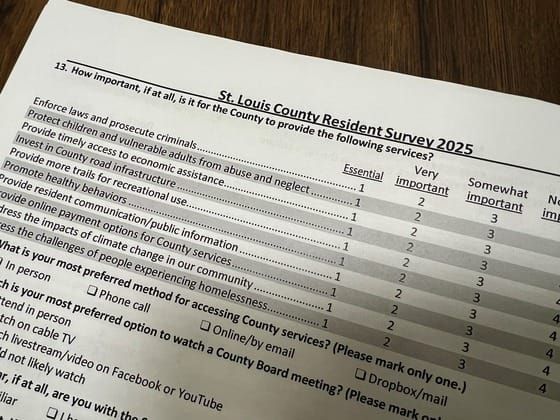
Questions about quality of life in St. Louis County, what people think of the job the County is doing at providing a wide set of critical services, and how much priority people think the County should place on certain services – St. Louis County is seeking public input on these issues and others in a survey that is being mailed out this week.
Information collected in the survey helps guide decisions on budgets, policy and more. New this year, the County will be seeking public input on topics including environmentally sustainable practices, and on investments in types of housing and services for people experiencing homelessness.

Approximately 4,900 County residents selected at random will receive a postcard in the mail inviting them to take the survey online. These residents will also have the option to complete a paper copy of the survey. Results of the survey, which are considered statistically valid, will be shared by early summer and will be taken into consideration by staff and commissioners as they work on the 2026 budget and long-range plans.
"We encourage our citizens, if you are one of the randomly selected households to receive this survey, please fill it out," said County Board Chair Annie Harala. "We very much value the opinions and information we gain from this survey. In some cases, it becomes rationale to redirect resources, and in other instance we find it reaffirms that people appreciate decisions we've made."

In addition to this scientific survey, the county will later offer an online survey that any citizen can complete. Those answers will be kept separate from the official survey but will still be reviewed and taken into consideration.
St. Louis County is partnering with four other counties – Dakota, Olmsted, Scott and Washington – to produce the survey, which is being conducted by Polco/National Research Center, Inc. The County has conducted similar surveys every two to three years since 2007, most recently in 2022.
Spread across more than 7,000 square miles, St. Louis County is the largest county east of the Mississippi River and is home to 200,000 people. For more information about the County, its government or the 2025 Residential Survey, call (218) 726-2450 or visit stlouiscountymn.gov.