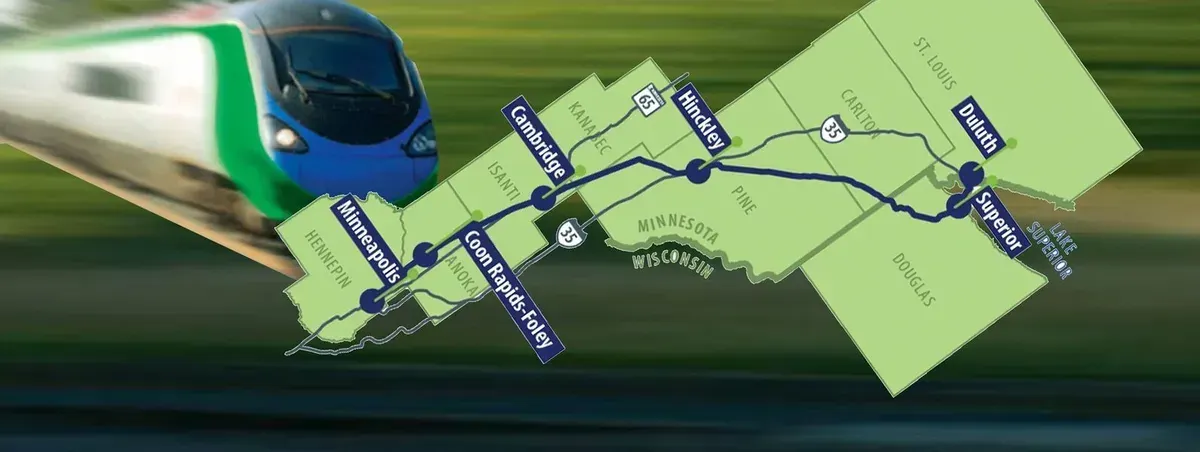
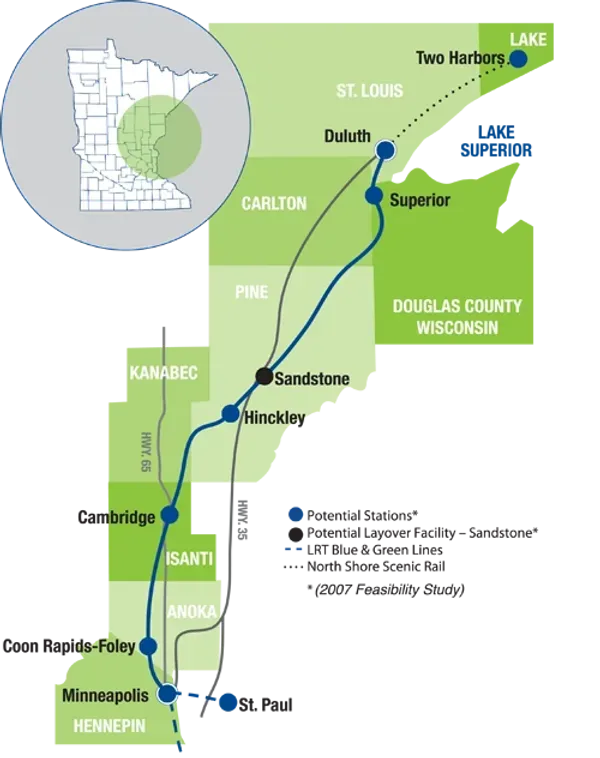
The Minnesota Department of Transportation announced it has received $500,000 in federal funds to advance the planning of the Northern Lights Express (NLX) passenger rail project. The federal grant provides funds to begin preliminary work on the project, which will provide four, round-trip, daily passenger rail trips from Minneapolis to Duluth/Superior.
Earlier this year, MnDOT applied for the Corridor Identification and Development Program grant through the Federal Railroad Administration. MnDOT will use the CIDP funds to begin updating planning work originally completed in 2017. The funds are a portion of the 80% funding needed from the federal government for the $592.3 million dollar project. This complements the state match received during the 2023 legislative session, when $194.7 million was appropriated for NLX.
MnDOT also applied for a Federal-State Partnership for Intercity Passenger Rail Program grant to fund final design and construction. MnDOT expects a decision before the end of 2023.
“We are eager to move this project forward to final design, but we still have some important steps ahead,“ said Greg Mathis, MnDOT planning director for passenger rail. “We will have a clearer timeline once we learn about the additional funding from the Federal Railroad Administration. Until then, we will continue to work with BNSF Railway, the NLX Alliance and local communities to get trains up and running.”